Books

Cultivating Food Justice: Race, Class, and Sustainability.

Alkon, A and Agyeman, J (eds), MIT Press, 2011 Purchase the book

Popularized by such best-selling authors as Michael Pollan, Barbara Kingsolver, and Eric Schlosser, a growing food movement urges us to support sustainable agriculture by eating fresh food produced on local family farms. But many low-income neighborhoods and communities of color have been systematically deprived of access to healthy and sustainable food. These communities have been actively prevented from producing their own food and often live in “food deserts” where fast food is more common than fresh food. Cultivating Food Justice describes their efforts to envision and create environmentally sustainable and socially just alternatives to the food system.

Bringing together insights from studies of environmental justice, sustainable agriculture, critical race theory, and food studies, Cultivating Food Justice highlights the ways race and class inequalities permeate the food system, from production to distribution to consumption. The studies offered in the book explore a range of important issues, including agricultural and land use policies that systematically disadvantage Native American, African American, Latino/a, and Asian American farmers and farmworkers; access problems in both urban and rural areas; efforts to create sustainable local food systems in low-income communities of color; and future directions for the food justice movement. These diverse accounts of the relationships among food, environmentalism, justice, race, and identity will help guide efforts to achieve a just and sustainable agriculture.

Environmental Inequalities Beyond Borders: Local Perspectives on Global Injustices.

Carmin, J and Agyeman, J (eds), MIT Press, 2011 Purchase the book

Multinational corporations often exploit natural resources or locate factories in poor countries far from the demand for the products and profits that result. Developed countries also routinely dump hazardous materials and produce greenhouse gas emissions that have a disproportionate impact on developing countries. This book investigates how these and other globalized practices exact high social and environmental costs as poor, local communities are forced to cope with depleted resources, pollution, health problems, and social and cultural disruption.

Case studies drawn from Africa, Asia, the Pacific Rim, and Latin America critically assess how diverse types of global inequalities play out on local terrains. These range from an assessment of the pros and cons of foreign investment in Fiji to an account of the work of transnational activists combating toxic waste disposal in Mozambique. Taken together, the chapters demonstrate the spatial disconnect between global consumption and production on the one hand and local environmental quality and human rights on the other. The result is a rich perspective not only on the ways industries, governments, and consumption patterns can further entrench existing inequalities but also on how emerging networks and movements can foster institutional change and promote social equality and environmental justice.

Environmental Justice and Sustainability in the Former Soviet Union.

Agyeman, J and Ogneva-Himmelberger, Y (eds), MIT Press, 2009 Purchase the book

The legacy of environmental catastrophe in the states of the former Soviet Union includes desertification, pollution, and the toxic aftermath of industrial accidents, the most notorious of which was the Chernobyl disaster of 1986. This book examines the development of environmental activism in Russia and the former Soviet republics in response to these problems and its effect on policy and planning.

It also shows that because of increasing economic, ethnic, and social inequality in the former Soviet states, debates over environmental justice are beginning to come to the fore. The book explores the varying environmental, social, political, and economic circumstances of these countries—which range from the Western-style democracies of the Baltic states to the totalitarian regimes of Central Asia—and how they affect the ecological, environmental, and public health.


Speaking for Ourselves: Environmental Justice in Canada.

Agyeman, J, Cole, P, Haluza-DeLay, R, and O’Riley P (eds), The University of British Columbia Press, 2009 Purchase the book

Speaking for Ourselves draws together scholars and activists -Aboriginal and non-Aboriginal, established and new – who bring equity issues to the forefront by considering environmental justice in specifically Canadian cases and contexts and from a variety of perspectives, including those of First Nations and women. The contributors expand notions of justice and the concepts involved in environmental justice beyond their European origins and limits to demonstrate new ways of working toward environmental sustainability and social justice.

This innovative, engaging collection gives a voice to multiple perspectives on environmental justice and its construction in Canada. As the first major examination of the multidimensionality of environmental equity and injustice, it will appeal to scholars across a wide range of disciplines in the social and environmental sciences and to activists and citizens who want to make Canadian society more just and sustainable.

The New Countryside? Ethnicity, Nation and Exclusion in Contemporary Rural Britain.

Neal S and Agyeman, J (eds), The Policy Press, 2006 Purchase the book

This book explores issues of ethnicity, identity and racialised exclusion in rural Britain, in depth and for the first time. It questions what the countryside ‘is’, problematises who is seen as belonging to rural spaces, and argues for the recognition of a rural multiculture.The book brings together the latest and most extensive research findings to provide an authoritative account of current theory, policy and practice. Using interdisciplinary frameworks and new empirical data, the book provides a critical and comprehensive account of the shifting, contested connections between rurality, national identity and ethnicity; discusses the relationships between ethnicity, exclusion, policy, practice and research in a range of rural settings – from the experiences of gypsy traveller children in schools to attempts to encourage black and minority ethnic visitors to National Parks and contributes towards establishing the ‘rural-ethnicity-nation’ relationship as a key consideration on political and policy agendas.


Sustainable Communities and the Challenge of Environmental Justice.

Agyeman, J., NYU Press, 2005  Purchase the book

In this book, Julian Agyeman argues that the environmental justice and sustainable communities movements are compatible in practical ways. Yet sustainability advocates have not always partnered with the challenges of environmental justice.

Sustainable Communities and the Challenge of Environmental Justice explores the ideological differences between these two movements and shows how they can work together. Agyeman provides concrete examples of potential model organizations that employ the types of strategies he advocates. This book is vital to the efforts of community organizers, policymakers, and everyone interested in a better environment and community health.


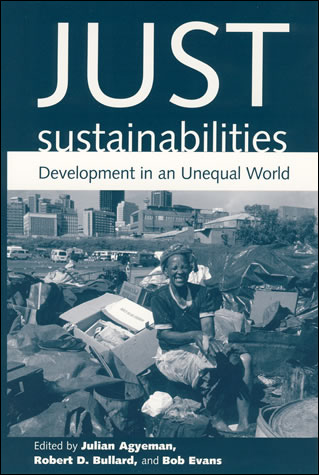
Just Sustainabilities: Development in an Unequal World.

Agyeman, J, Bullard, R, Evans, B (eds) MIT Press, 2003 Purchase the book

Just Sustainabilities argues that social and environmental justice within and between nations should be an integral part of the policies and agreements that promote sustainable development. The book addresses many aspects of the links between environmental quality and human equality and between sustainability and environmental justice more generally.

The topics discussed include anthropocentrism; biotechnology; bioprospecting; biocultural assimilation; deep and radical ecology; ecological debt; ecological democracy; ecological footprints; ecological modernization; feminism and gender; globalization; participatory research; place, identity, and legal rights; precaution; risk society; selective victimization; and valuation.

Comments are closed.